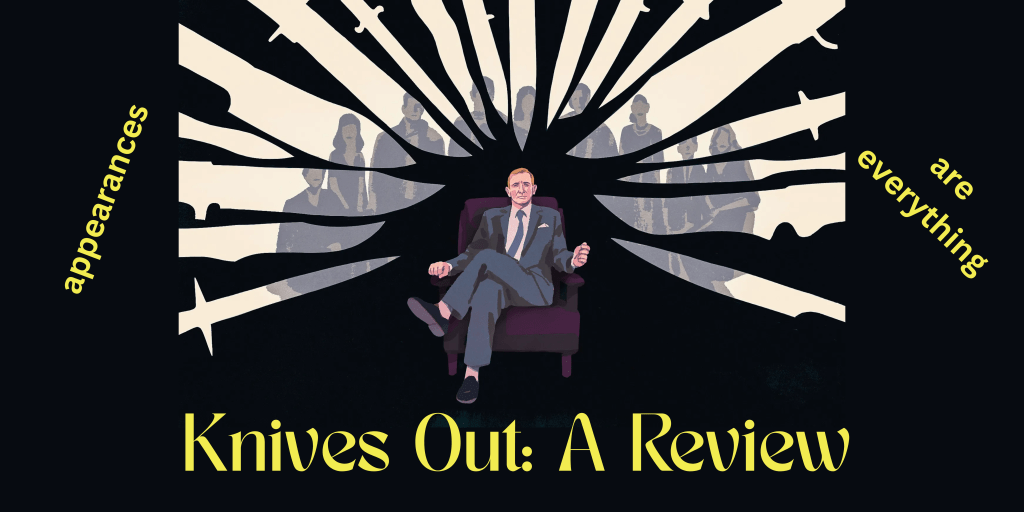
[SPOILERS ahead]
As is sometimes the case in the theater, this movie review requires a bit of prologue. If you read the review of Free Guy, you might remember that I offered a similar disclaimer. Just because we’re chatting about Knives Out, it doesn’t mean I necessarily endorse it. Some viewers might find the harsh profanity, murder (!), and occasionally problematic dialogue to be less Agatha-Christie-nostalgic and more of the uh-oh-let’s-swap-this-for-a-Pixar-film type.
So maybe you love this theatrical murder mystery–or maybe you consider it a solid “skip” for movie night. (After all, Finding Nemo has a lot less knives).
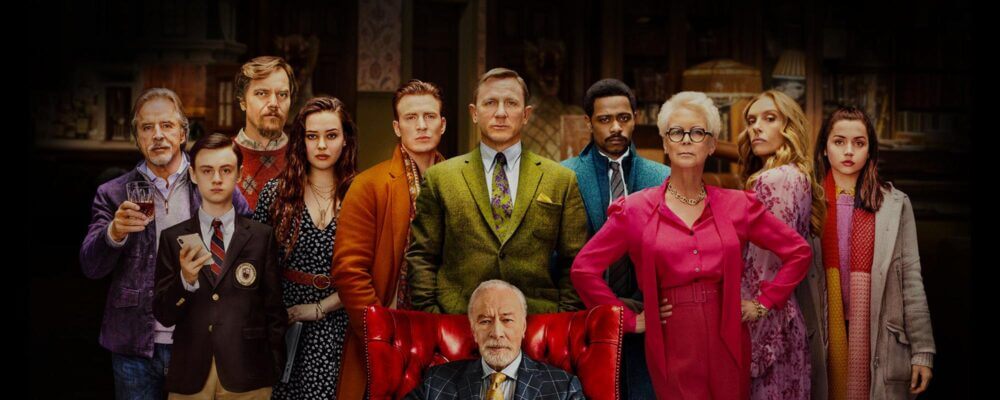
But whether you’ve seen it, love it, hate it, or are currently looking up the Wikipedia page because you’ve never heard of it, let’s jump in as we explore the melodramatic, mysterious, and surprisingly meaningful murder mystery. Hold on to your hats (and your assumptions) because this theatrical drama is about to flip reality itself upside down.
novel drama
Harlan Thrombey may have been a world-famous mystery writer–but, in many ways, he was born for the stage. From his massive estate that could be straight from a Christie novel to his flair for the dramatic, Harlan was somewhat . . . theatrical. Some might even say eccentric, but that didn’t matter. His three children have given him three dynastic clans that were almost as respected (and insanely rich) as he was. There was his oldest child, Linda, a type-A personality who married the picture-perfect Richard. Together, they had a strapping and spoiled adult son, Ransom, who’s profession was mostly lazing around the pool.
Harlan’s second kid was Neil, a son who passed away after marrying Joni and having Meg, now a college student embracing nonconformism and feminist studies. Joni tries to appear more zen than her daughter (except when it comes to money) and runs a wealthy wellness company that *almost* keeps her from being just as about-to-tear-her-hair-out from the pressures of success as her sister-in-law Linda.

Harlan’s last kid, Walt, is (as one might have guessed) equally ambitious, wealthy, and respected as his sisters. The grizzly-bearded youngest Thrombey son is in charge of publishing Harlan’s successful books, while balancing his family responsibility to soft-spoken spouse Donna and their increasingly troubled, ideologically unstable son Jacob.
Happy family, right? Despite what may be overheard behind closed doors, the Thrombey family sure seems so during Harlan’s 85th birthday party. How could wealthy, beautiful people not be loved? Unbeknownst to his children, however, Harlan Thrombey really only considers one person among his relatives a true friend: his home nurse, Marta Cabrera. The young woman is described in Knives Out as having “a kind heart,” a trait that Harlan is drawn to as his own final act is drawing to a close. But the others? Harlan tells Marta that they’ve gotten so entangled in riches and status, nothing seems real to them anymore. It’s like they can’t tell a stage knife from a real dagger, he says.
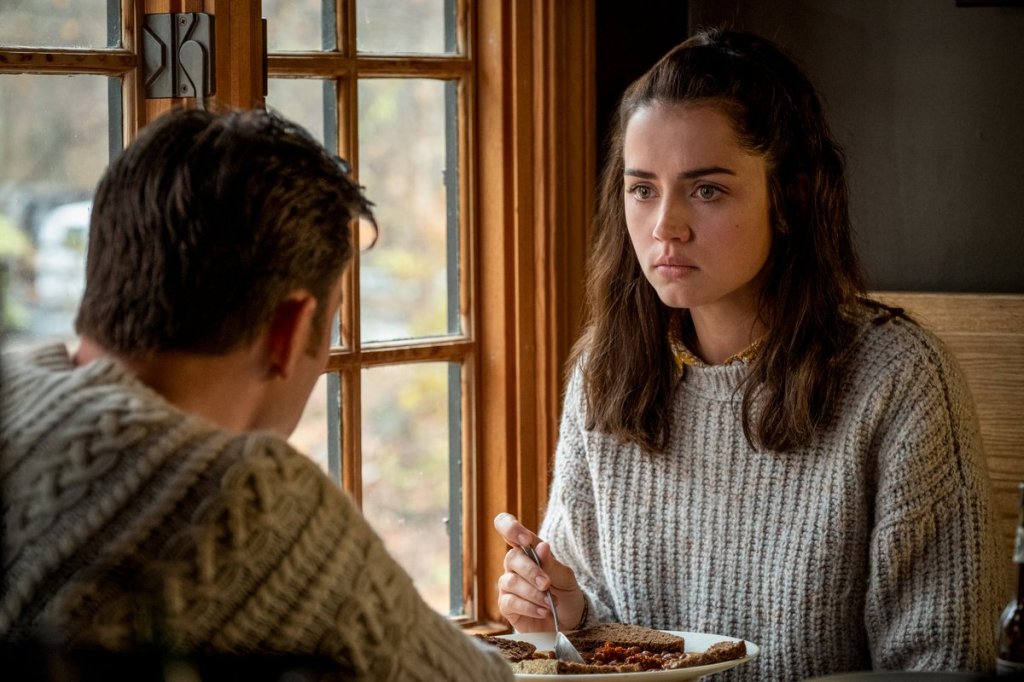
And among the things they can’t see is Marta. Only Harlan notices her. To everyone else, they see the daughter of a South American immigrant (no one can remember the country) who gives Gramps pain meds and plays the boardgame Go with him on rainy afternoons.
That’s why, when Harlan Thrombey is found theatrically killed by an ornate knife blade, the last one they would ever suspect is Marta.
keeping up appearances
Knives Out certainly knows how to keep the audience on its toes. By the time gentleman detective Benoit Blanc [Daniel Craig] strides onto the scene with his white suit and drawling Kentucky accent, the Thrombey family is already in a flurry of panic. Secretly, Marta believes she’s killed Harlan. The police detective Wagner thinks Harlan killed himself. Two others in the family believe they know the identity of the killer. And absolutely everyone is hiding a dark secret. With all the lies flying about, nothing is as it seems.

Despite her apparent guilt, however, Marta is the only suspect that Benoit Blanc (or us) has any sympathy for. After all, she really does have a kind heart. Despite the mourning his death causes for his children, Marta still is the only one who had a genuine connection with Harlan before he passed. Maybe a lot of the good-wealthy-beautiful-people the Thrombey dynasties portray is just an act. Perhaps they are more destined for the stage than even the great Harlan.
Which raises the question, as powerful as any whodunnit. What is the power of appearances? And do they really matter, anyway?
whitewashed
A murder mystery may be a strange place to look for allegories and analogies. But–maybe not. After all, classic whodunnits are normally about life and death, innocence and guilt, justice and mercy. Very life-y kind of stuff, if the writers allow it.
One could argue that Knives Out is a murder mystery about whitewashed tombs. As Jesus tells the high-and-mighty Pharisees: “You are like whitewashed tombs, which look beautiful on the outside but on the inside are full of the bones of the dead and everything unclean” and “on the outside you appear to people as righteous but on the inside you are full of hypocrisy and wickedness” (Matthew 23:27-28).
Ouch.
This lesson that Knives Out delivers is meaningful–and just as sharp as the plot-twist-filled mystery itself. In the end, it turns out that appearances matter very little. Who cares if perfect-daughter Linda or suave-trust-fund-kid Ransom or fabulous-CEO Joni or publisher-guru Walter any of the lot are respected? Well, who cares besides themselves. The Thrombey really want respect and power, and they know money is the ticket to all their hearts’ desires. You can be a cheater, a sneak, a jerk, and–just possibly–a murderer, if you have enough money.
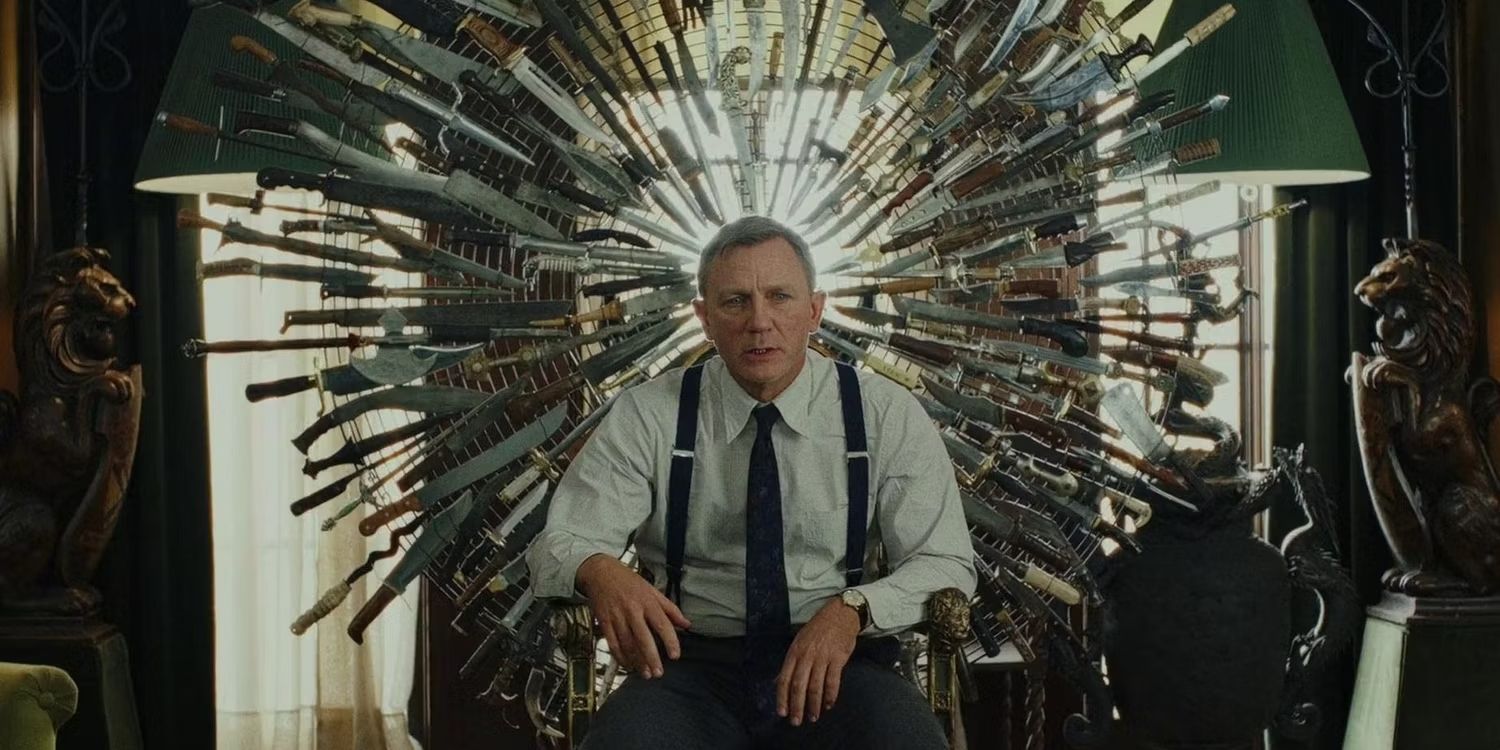
But, as we can all have deduced, appearances backfire. Even if it takes a lifetime, truth will out in the end. So it was Harlan Thrombey’s last great mystery that he wrote for the world (and for his children): how you treat people counts infinitely more than the seemingly indestructible veneer of stuff. You might even say that it’s those with “a kind heart” that are the true gems.
Everything else is just prop knives.
conclusion
A friend once told me at university that the only things in life that are going to last forever are people and the Word of God (and, you could argue, the Earth because God will renew it and make it perfect. But you get the idea). Certain stuff like human beings are literally lasting forever. Stuff doesn’t.
I thought about that for a long time afterward. My grades weren’t going to last forever? Or my attempts at running a 5k? Or my quest for the perfect slice of pizza? (Clearly, my priorities are wobbly here). What about my career? Or my dream-life I had floating foggily yet persistently in my imagination?
I was rocked by a fresh realization that the way we treat people is really, really meaningful. People are God’s treasure. He loves when we invest our lives in beautifying the world and the people within it. At the end of the day, who cares if we have the Thrombey fortune or the Thrombey pride or the Thrombey elegance?
It doesn’t take deductive genius like Benoit Blanc to figure out that the real win is to love God and love others. (If I happen to also get a Thrombey family fortune, I’m not complaining). But it’s not essential. THAT’S just play-stuff. The real stuff is what matters.
And that’s the story, the drama, that Harlan Thrombey himself wanted for his family: for them to live and experience life genuinely. Freely. Prop-knife-less and all for-real.
Just like his best friend Marta.
Thanks for reading this post on Knives Out! Hopefully (whether you decide to watch the movie or not), you’re inspired to think about mystery that the real stuff in life is often simple-and that you feel prompted to come to Jesus for true joy 🙂 After all, He has a kind and gentle heart for anyone who comes to Him.
Join us next week as we jump red-ruby-shoes first into a lighter world–one where a magical quest for justice leads to unimaginable new heights.
Main Image credit: Illustration by Patrick Leger, appearance in The New Yorker. Edited in Canva.

 Joy H. Books
Leave a comment